


Table of Contents
Introduction: The Rising Popularity of Lab Grown Diamonds
The world of fine jewelry is constantly evolving, with growing interest in alternatives to traditional diamonds. Among these alternatives, lab grown diamonds and moissanite are two popular choices, each offering unique advantages. While lab grown diamonds are chemically identical to mined diamonds, moissanite is a completely different gemstone. This article will explore the differences between moissanite vs diamond, shedding light on the role of lab grown diamonds in this evolving market.
What Are Lab Grown Diamonds?
Before diving into the comparison between moissanite vs diamond, it’s important to understand what lab grown diamonds are. These diamonds are created in controlled environments, simulating the natural conditions that produce diamonds deep within the Earth. Using advanced technology like High Pressure High Temperature (HPHT) or Chemical Vapor Deposition (CVD), lab grown diamonds form from carbon atoms, resulting in a stone with the same physical, chemical, and optical properties as a mined diamond.
While both moissanite and diamond are brilliant and hard gemstones, lab grown diamonds offer a sustainable and ethical alternative. They are produced without the environmental and ethical concerns associated with traditional diamond mining, making them an increasingly popular choice for conscientious consumers.
What Is Moissanite?
Moissanite is a naturally occurring mineral composed of silicon carbide. It was first discovered in 1893 by French chemist Henri Moissan. While moissanite is not technically a diamond, it is often compared to diamonds because of its similar appearance. However, there are notable differences between the two gemstones.
Moissanite is created in labs using advanced technology to replicate the natural process that forms this rare mineral. Unlike lab grown diamonds, moissanite has a different chemical structure and distinct optical properties. Although it shares some visual similarities with diamonds, it is not made of carbon and is, therefore, a unique alternative to traditional gemstones.
The Key Differences: Moissanite vs Diamond
1. Brilliance and Sparkle
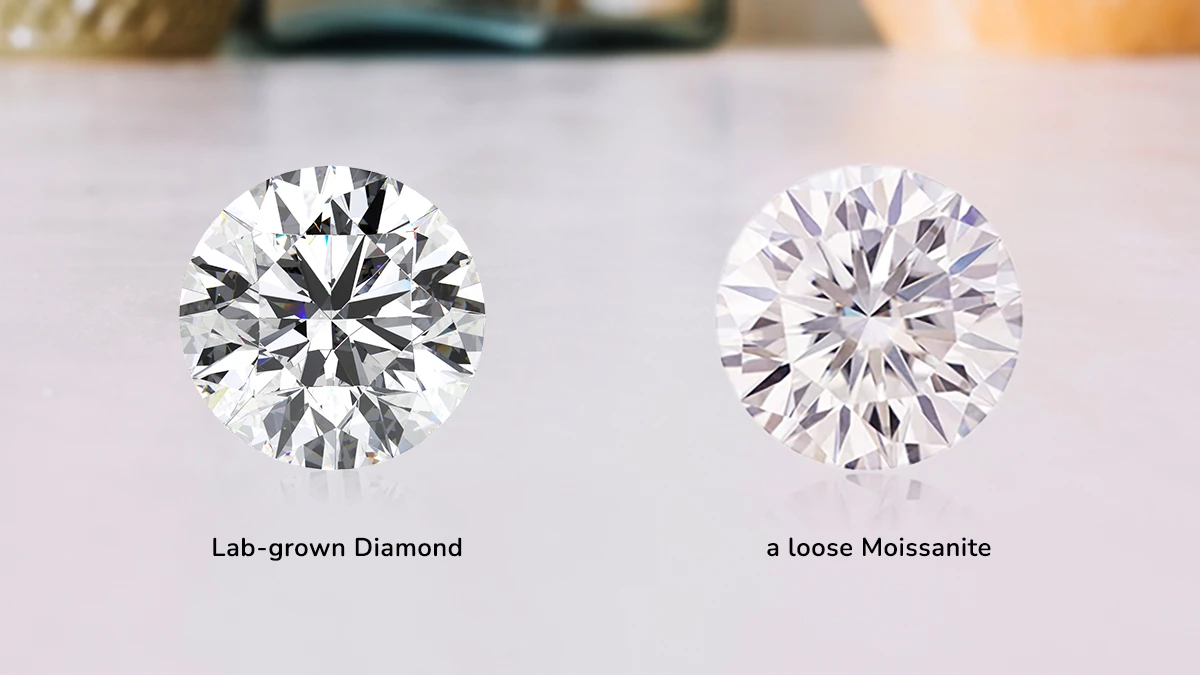
One of the most noticeable differences between moissanite vs diamond lies in their brilliance. Moissanite has a higher refractive index (2.65 to 2.69) than diamonds (2.42), which means it exhibits more sparkle and brilliance under light. Due to this higher refractive index, moissanite stones can appear more dazzling than diamonds in certain lighting conditions, which is a key factor for some buyers.
Lab grown diamonds, on the other hand, have a brilliance that is nearly identical to mined diamonds, since they share the same physical properties. While moissanite shines with a fiery intensity, diamonds, including lab grown diamonds, exude a classic, timeless sparkle that many people find more desirable for fine jewelry.
2. Hardness and Durability
Diamonds are renowned for being the hardest natural material on Earth, scoring a 10 on the Mohs scale of hardness. This makes diamonds incredibly durable and resistant to scratching. Lab grown diamonds are equally hard, as they have the same structure and chemical composition as natural diamonds. This makes them ideal for everyday wear, particularly in engagement rings and other fine jewelry.
Moissanite, while still very hard, ranks at 9.25 on the Mohs scale, making it slightly less durable than diamonds. While it is still a very durable gemstone, it may be more prone to scratching over time compared to diamonds, especially in pieces that see heavy wear.
3. Color and Clarity
Both moissanite and diamonds, including lab grown diamonds, can come in a range of colors, from colorless to light yellow or brown. However, moissanite tends to have a slight yellow or greenish tint, particularly in larger stones, which is more noticeable in certain lighting. Diamonds—especially high-quality lab grown diamonds—are often more colorless or exhibit a more neutral hue, making them more desirable for those seeking a flawless, clear appearance.
In terms of clarity, both moissanite and lab grown diamonds can be found in a range of clarity grades. However, diamonds (including lab grown diamonds) are typically graded using the GIA scale, while moissanite is graded on a different system. High-quality lab grown diamonds tend to have fewer visible inclusions, contributing to their higher value and appeal.
4. Price
Price is another area where moissanite and lab grown diamonds differ significantly. Moissanite is generally much more affordable than diamonds—whether natural or lab grown. This affordability is due to the fact that moissanite is not as rare as diamonds, and its production is less costly. For buyers on a budget who want the appearance of a diamond without the high price tag, moissanite can be an appealing choice.
Lab grown diamonds, while more affordable than natural diamonds, still carry a higher price tag than moissanite. However, for those seeking the true diamond experience, lab grown diamonds offer a balance of quality, sustainability, and value.
5. Environmental and Ethical Considerations
Both lab grown diamonds and moissanite have strong ethical advantages over mined diamonds. Lab grown diamonds are created in a controlled environment, meaning they do not contribute to the environmental destruction associated with traditional diamond mining. Additionally, they are conflict-free, ensuring that no human rights violations were involved in their production.
While moissanite is also created in laboratories and does not have the same ethical concerns as mined diamonds, it is important to note that it is not a diamond. For those specifically looking for a diamond, lab grown diamonds offer a true diamond experience with a sustainable, ethical approach.
Conclusion: Moissanite vs Diamond – Which is Right for You?
When comparing moissanite vs diamond, it ultimately comes down to personal preference and priorities. If you’re seeking a gemstone with more sparkle and affordability, moissanite may be the right choice for you. On the other hand, if you want the classic, timeless beauty of a diamond—with the added benefits of sustainability and ethical sourcing—then lab grown diamonds are an excellent option.
Both moissanite and lab grown diamonds offer consumers the opportunity to own beautiful, high-quality stones without the environmental and ethical concerns tied to mined diamonds. The choice between moissanite vs diamond comes down to your individual preferences, style, and values.